Pages

Wednesday, 9 August 2017

Skimming & Scanning


LI to identify the main ideas in a text.

For this activity I had to create an infographic about skimming and scanning. We were given an example of what skimming and scanning would be if they weren’t for reading, the examples were a helicopter for scanning and an aeroplane for skimming. After I’d finished my infographic I then decided to make another example of skimming and scanning.

I did this by using my general knowledge to write down what skimming and scanning were and why the examples were helicopters and aeroplanes and also by using google shapes for creating the examples.

Tuesday, 8 August 2017

Advertising Evaluation

LI we are learning to be able to identify what makes an effective advert.

For this activity I had to go into partner or be by myself, I chose to partner up with Jack. After we’d partnered up we then had to watch/read 5 advertisements and then answer some questions about them. Some examples of the questions are: Who do you think the intended buyer is?, What kind of advert is it? And what words do they use to sell the product?
Advertisement
We did this by reading and watching the videos properly to try not to miss anything and also by thinking about the questions to try and make sure we answered them fully.
Name of product
Coca-Cola.
Who do you think the intended buyer is?
People that need a  refreshment, and people who like coca cola.
What kind of advert is it?

TV                           Radio                  Magazine           Poster
How do they try to persuade you to buy it?
Tick:

With pictures      

With words        

With music

With questions


With jokes   

With catchphrases

With jingles

Other: ____________________
__________________________
Do you think it is a good advert?

           Yes          No

Why?
Because it grabs people's attention
Would you buy the product?            Yes                No        
Yes
Why?
Because coca cola tastes nice and also because it’s a fizzy drink and fizzy drinks have lots of sugar.
Do you think the advert is honest?  Yes                     No

Why?
No because there’s no possible way of what the polar bears had done in the ad.
What words do they use to sell the product?
Happiness

Monday, 7 August 2017

Summarising Duck Overboard Article

L.I. To look for keywords and phrases
L.I.   To identify the main ideas in the text

For this task I had to summarise an article called duck overboard, the article is about a bunch of plastic toys that were lost overboard when a storm hit the boat that was transporting them. The plastic toys then travelled around the world only being pushed by the ocean currents, an oceanographer called Curtis Ebbesmeyer realised how good these plastic toys would be for charting the ocean’s currents. Since then there has been a $100 reward for finding one of those toys. The toys have travelled far and wide from Australia and even to Antarctica!  
I did this by reading the article, answering the questions and using skimming and scanning to find all of the relevant information.
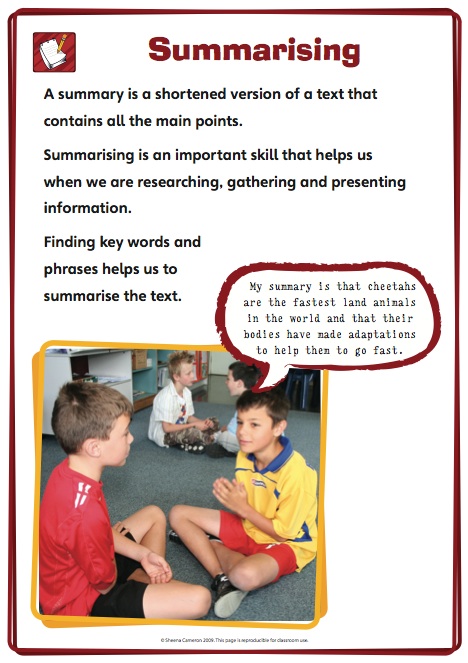
Summarising the Main Idea


Summarising.jpg
Good readers notice key words.  Here are some clues to help you find key words:
  • Key words are directly connected to the topic
  • Key words are often repeated in the title and the text
  • A key word helps you to remember an important idea
Use this table to help you summarise the main ideas in a text in your own words.  It is important that you use your own words to show your understanding and to avoid plagiarism.  If you don’t know what some words mean, look them up.

Keywords from the title
Overboard
Keywords from subheadings
New words I need to look up

Read the text and record key words/phrases that answer these questions:

What?
Storm knocks plastic ducks overboard.
Where?
In the ocean & countries all over the world.
When?
January 1992.
Who?
Curtis Ebbesmeyer.
Why?
To chart the ocean currents.
How?
The ocean current push the ducks all around the world.

Now using the words you wrote down summarise the text in 25 words or less.

A storm spilt thousands of plastic toys into the ocean, since then the ducks have travelled all around the world and helped chart ocean currents.

Friday, 4 August 2017

Reflection, Rotation and Translation

LI to transform shapes using reflection, rotation and translation.
For the first part of these activities I had to draw a horizontal line and a vertical line in my maths book, once I’d done that I then had to number it. I then had to draw a shape, label its corners A, B, C and D and then make a copy of it and translate it (maths version). Once I’d translated the copy of the shape I then drew the line of reflection and reflected the copy, after I reflected the copy I then had to draw a point of rotation and make a copy of the reflection and rotate it 90 degrees.
I did this by using a ruler to make the straight lines, imagining what the shape would look like rotated and reflected and also by using the vertical and horizontal lines to figure out where the shape was and where it would go.
I also did an audio recording to go with this slide.

Imagery In Media

LI: to identify how people are being influenced.

For this activity I had to find a partner, I partnered up with Andrew. Once we were in our partners we had to make a copy of the slideshow and write the answers to the questions in the comments/suggestions section below the slide. The type of questions we had to answer were ones that asked what is the advertisement trying to say and what kind of imagery was used. There were advertisements that were on posters and three Coca Cola advertisements that had videos.

We did this by looking at the posters and watching the videos to answer the questions.

Thursday, 3 August 2017

Advertising products

LI To recognise and understand the purpose of advertising (Persuasive) language features.

For this activity I had to get into a partner or into a group of three, I got into a group with Jack and Julian. Once we’d gotten into a group I had to go on the six documents and make a copy of them (the seventh was an example). Once I’d made a copy of all of them I then shared them to my group mates, after they were shared into them we had to answer these questions about the advertisement: What product or service is being advertised?, Who might be interested in the product or service?, Is there a catch phrase or slogan for the product?, What message is the advertisement trying to say about the product? And how may the advertisement make the user feel?

We did this by researching about the slogan/catchphrase, looking at the pictures to find hints and thinking about how the advertisement would make people feel.


Wednesday, 2 August 2017

New Zealand's Political History Learning

Yesterday Mr Ogilvie's reading groups went up to LS2 to research New Zealand's political history on a timeline, we had to use skimming and scanning to quickly find the information and write it down on a piece of paper. We kept on skimming, scanning and writing the information down until we were called to the whiteboard and it was there that we had to ask some questions. Some questions were "What caused the parliament building to burn down?" and "How long were the breaks in William Lee Rees' a bit over 24 hour speech?"

Some more questions that Jack and I have are:
Why did some men not want women to be able to vote?
What was William Lee Rees' bit over 24 speech about?
Why does a ceremonial mace let the Serjeant at arms become an official in the parliament?