Pages

Monday, 3 September 2018

Novel Study - Billionaire Boy

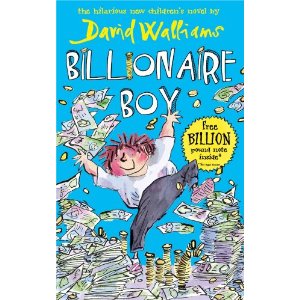
Image result for billionaire boys book

This term for reading Mrs Anderson has made reading fun for our group by introducing a novel study, for it we needed to partner up and in those partners our task was to read the same book or books by the same author and then complete tasks. This was a great opportunity for people who don't like reading to love reading. This is a fun reading task because we get to work in partners. I'm working with Ofa and together we  chose the book Billionaire Boy. We decided to choose this book because there were two copies for us. This book talks about a boy name Joe Spud who's the richest 12 year old in the world. Joe Spud is spoilt by his rich dad who owns a toilet-paper making company. He's gotten anything he's every wanted like more than 400 pairs of Nike trainers and a roller coaster in the back garden. We're still reading so we'll need to finish the book for the ending.

Friday, 31 August 2018

Animated Story: Scratch Project

In the context of In the neighborhood I will design and produce An animated story for Children 6-13 to be used to inform
the target audience of how littering is a bad thing to do.

My animated story is currently under construction, could you please help me by giving me feedback on my conceptual design of my animated story.

Wednesday, 29 August 2018

Bridge Comparison

For Inquiry this term our topic is structures. Today we were looking at bridges. In pairs we were to create a Venn Diagram comparing the Auckland Viaduct Harbour Bridge with the Golden Gate Bridge. My partner was Alex. I learnt that 11 people past away during the construction of the Golden Gate Bridge. Did you know that cars can't cross the Auckland Viaduct Bridge.

Maths Division Problem

Today during maths we had three pretty easy problem to complete, after we'd finished it we then needed to create a DLO on it. After that we were allowed to play this game.

How To Tell Analogue Time

This week for writing our task was to create an explanation on how to read analogue time from a clock, surprisingly lots of children and teenagers don't know how to tell the time from analogue clocks and watches. I tried to make this as easy as I could to understand so if you don't I'd suggest asking someone else.
Analogue  Time


Analogue clocks and watches aren’t hard to use, once you know how, they’re as easy
as reading digital ones.


The long and short hands both represent something, the long hand is used to show
the minutes and the short one for the hours. The long hand goes around faster than the
shorter one because minutes are shorter than hours. An example of telling the time
with an analogue clock is this; if the long hand is on the 9 and the short hand is near
the 4 then the time is 3:45.


One way to help people tell the time is by using past and to, from the beginning of the
hour to 30 minutes afterwards the usual way to tell the time is by saying ten-past,
quarter-past or half-past and the way for 31 minutes to the 60th is to; ten-to, twenty-to,
etc.

Although time might seem hard to tell using an analogue clock, as long as you know
what the hands are used for clocks shouldn’t be hard to read.

Tuesday, 28 August 2018

Tunnel Purposes


For inquiry Ms Kirkpatrick's group needed to first get into our pairs, after that we then needed to either research different tunnel materials used for construction or the different tunnel purposes. I worked with Fraidoon, and together we found a few types of tunnels that everyday people use. Researching the different types was pretty hard because we didn't know many tunnels.

Friday, 24 August 2018

Kiwi Can

This week in Kiwi Can we were learning more about values, we also played two games, one of them was hand-knots and the other a type of dodge ball. for the hand-knots we were separated into three different groups, each with six people. in those groups we needed to hold  the hands of two people that weren't right next to us. After that was done all of the hand should've been in the middle, on top of each other. the task from then on was to somehow untangle ourselves. My group came last for that activity. For the dodge ball game we needed to get into a circle and in that circle the we were numbered from one to four. When your number was called out you and your group needed to get into the middle and the other groups needed to work together to roll the ball into you as fast as they could.